
If more than 18 minutes of cardio is wrong, then what the hell should I do?!

Proponents of Sprint and Interval Training have been showing these pictures since I was an undergrad. The point is sound: do you want to look like an emaciated marathon runner, or would you rather be built like an elite sprinter? Since these athletes train completely different, the choice is yours. Yes, all true. But I’d like for you to go back and look at one glaring difference in these photos (hint: it’s not the muscles, the speed, or the sex appeal). Look at the difference in facial expressions. The sprinters are focused, determined and in the zone, while the marathon runners look absolutely miserable! This says more to me than anything else on display.
Life is hard enough: jobs, kids, obligations, sleep disruptions, and injuries. Exercise shouldn’t make it worse. I want clients to be freed from the obligation to exercise more, lift more, run more, and be miserable. Ideally their training takes less than 20 minutes at a time (maybe even less than 10). I want training to build their bodies up and bring the joy back. Overtraining does the opposite. Remember, cardio makes you fat.
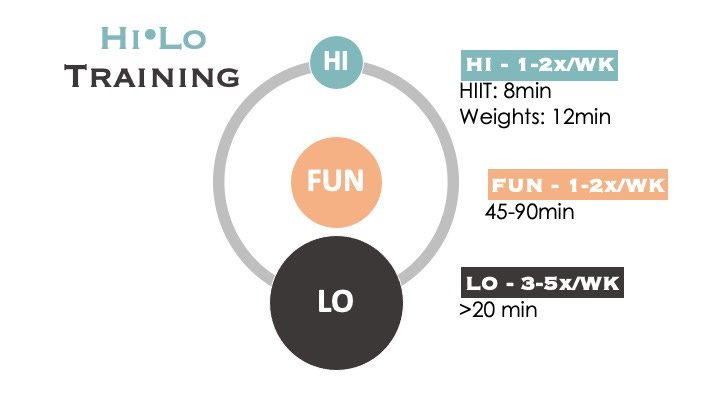
This is the model our clinic uses when programming for clients and ourselves. Some coaches will call this periodization or polarized training. We call it ‘HI:LO’ but the concepts are the same. For the best longevity outcome, we need to train multiple systems in the body, but we don’t want to overtrain any one system. Strength is absolutely key as we age, but synergizing strength with stability, endurance, and balance protects us from injury and elicits the best long-term results. Here’s how the HI – LO – FUN spheres break down…
Training HI
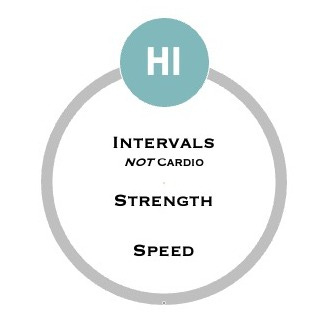
HI = High Intensity. Running maximum mileage will lead to injury, but so can heavy strength training and speed work. The key to the ‘HI’ circle is that it’s small…you aren’t doing very much of it, because training for strength, speed, and agility tend to involve higher-impact exercises (necessary, but dangerous in higher amounts). That’s why I start with a 20 minute limit. If a program is done correctly, you should be able to get all the strength, speed, and power work you need within that time limit. Our goal is to get someone their daily workout in less time than it takes to change clothes and drive to the gym. Interval training is the best way to accomplish that goal with minimal impact to the body.
This is what a typical ‘interval’ looks like. I’m warmed up at this point, so I’ll push as hard as I can on the bike for 15 seconds, take a 45-60 second break (depending on how wiped I am) and then repeat 2-4 times (so I’m only on the bike for 7-8 minutes). The shorter intervals boost my testosterone, aerobic endurance, and mood, all while lowering my cortisol and stress (note: women also get a testosterone and estrogen boost with this method…more below). And, since I’ve only burned 8 minutes on these intervals, I’ve got plenty of time and energy left to train strength and speed safely.
Same goes for my client. If they’ve just knocked out 45 minutes of cardio, and then I add the load of speed and strength exercises, injury will be the result. You should have enough left in the tank after cardio to perform speed and strength moves safely. You can’t maintain speed and strength long-term if you are too injured to train long-term.
Marci here…Women’s Health PSA: women need far longer recovery between intervals to receive the same benefit. Our tissues and hormones do not recover like men’s. You need to rest 4-5 minutes between each interval or you are suppressing sex hormones and raising cortisol. This gives you time to do some strength training, mobility/stability work, etc before your next interval. Good news is you can get the rest of your workout in during those rest times!
Training LO

LO = Low Intensity. This circle is for all of our easier exercise: walking, hiking, slow yoga, easy biking, and massage/stretching/tissue work. It’s the biggest circle, so you get to do the most of it. The key to ‘LO’ training is recovery. You are keeping your heart rate low, focusing on caring for your body and promoting adaptation from harder training days. ‘LO’ training allows you to build resilience in your tissue so that the ‘HI’ training days don’t blow up your body. Most of us aren’t training for a race in 3 weeks. We are training to live well for the next 40+ years. We are training to have fun.
FUN - I love it. It’s terrible for me.
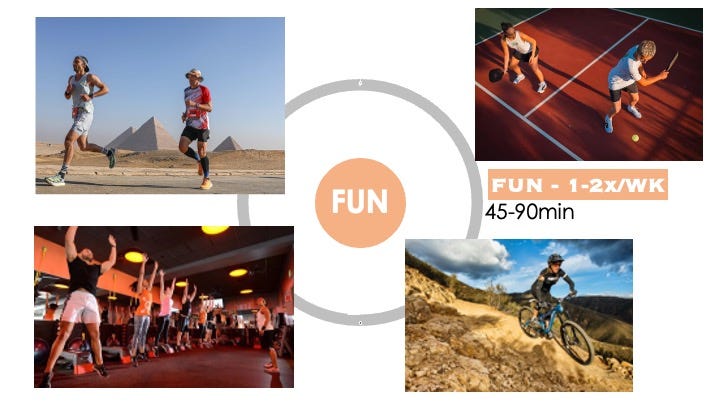
Training can be FUN, but FUN isn’t TRAINING. I know…word salad. Let me explain. ‘FUN’ activities are what we train for – they are why we train. ‘FUN’ can be a sport, a favorite activity, a social exercise class, or just chasing your kids through a busy life. ‘FUN’ encompasses the activities that we love and are usually really bad for us: running, pickleball, downhill mountain biking, and exercise classes. It’s ok that some of what we love most about life is bad for us…that’s what makes life worth living.
For me, it’s basketball. I’ve played with the same group of guys going on 20 years. Same day. Same time. I love it despite how horrible it is for my body. Many of our group have gone on injured reserve over the years and never come back. Basketball is high impact, dangerous, and incredible :-). Playing more basketball might make me better at basketball, but it won’t build resilience in my tissue or prevent me from being crippled. So, I play one day a week for 90 minutes and then spend the rest of the week balancing HI and LO training in order to recover and prepare for the next week’s game. Training this way allows me to continue playing the game I love for as long as possible.
If you are pounding yourself with sport, exercise classes, or any other high-impact activity in an effort to lose weight and stay fit, your body will break before you ever see long-term results. That type of pounding also does not have the effect on weight loss and changes in body composition like we have been told. And that is no FUN.
Here’s the key guideline: if you are exercising for more than 20 minutes, it had better be FUN. This is an example of a safe and balanced weekly training calendar:
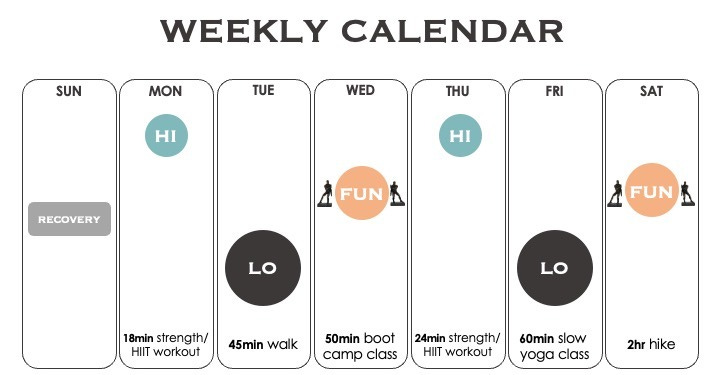
I get it – training for 18-25 minutes seems like it’s not worth while. That’s the point. Most people don’t have (or even want) 90 minutes a day to train, so even 20 minutes puts you way ahead of the curve. And, not having the time means you are less likely to over-train in the first place. Try it for a week. I promise your body will thank you.

Live Long. Live Well.