
Summer off-season for adolescent sports is almost here. Doing less will keep your kid injury-free and ready for Fall.
Sanctimonious Advice?
This is yet another opportunity to provide parenting advice from a non-parent. I don’t have kids, but my clients do, and their kids are hurt far too often. Bottom line: your kids are doing too much training as it is. Without adequate recovery and off-season conditioning, kids are going into Fall with an elevated risk of injury and mental burnout. My goal here is to provide an accessible template that kids can follow to improve performance, speed recovery, and avoid injury all at the same time.
Dog Days of Summer
Working out over Summer as a kid was absolutely the last thing on my mind. My adolescent off-season training consisted of laying around the house, watching Knight Rider, and counting down the days until our annual Port Aransas adventure. Any sporting event we participated in had to randomly erupt in someone’s driveway. This took me through late August, when it was finally time to go get new basketball shoes and try to finish my assigned Summer reading in the 24 hours before the first day of school. Once practice started, nobody was moving very fast because nobody had done any training for 2 months.
I sound like my grandfather, but things couldn’t be more different now. Rather than spend Summer lazing around and recovering from over-scheduled Winter and Spring sports, kids are booked up with athletic camps and club teams. If they’re lucky enough to get some time off, these kids are often encouraged to follow a team’s “off-season” conditioning program. I’ve seen dozens of these programs for young athletes handed out by everyone from coaches to international sports organizations. Most of these training guides have the same fault in common: they require WAY too much training for the off-season, especially when compounded on top of Summer sports.
2 Weeks Notice…
We should all feel good that kids are staying busy and engaged enough for video games and drugs to lose their appeal, and I don’t think my feckless Summers are necessarily the answer. What kids need is a structured off-season training plan that blends the right volume of conditioning, mobility, and tissue recovery. Note: off-season isn’t restricted to Summer – your kid can run this program any time she has more than 2 weeks off. Why 2 weeks? Because all of us, adolescent and adult alike, should take 2 weeks completely off from training every year. This extended recovery drops the risk of injury and burnout dramatically.
So ideally the first 2 weeks of break are spent doing minimal to NO organized training (driveway pickup games are an important exception:-). This gives kids the opportunity to become antsy and actually miss exercising (not to mention giving their growing tissue the needed time to heal and repair). Once off-season starts, these are our top 3 goals:
Keep The Volume LOW
When it comes to training, more is never better. We want the maximum performance outcome with minimal input, leaving ample time for play, rest, and enjoyment. 20 structured minutes a day is plenty, and everything else should be fun.
Reduce Joint Impact
Off-season training is pointless if it pounds kids joints as hard as the regular season. That’s why we limit the loading and diversify the input.
Balance Endurance, Strength, and Tactical Training
Don’t do the same thing every day. We know the body adapts better when training stimulus varies. And guess what: it’s a ton more fun.
The Brass Tacks
Here’s what a standard weekly off-season template looks like. *I’ll post an example of the “Strength Day” workout at the end of the article so you can see specific exercises.
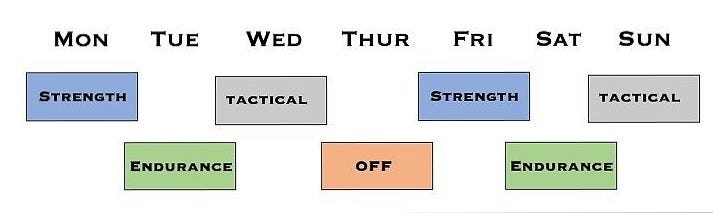
By alternating Strength, Endurance, and Tactical (sport specific) training days, we can stick to a 20-minute time limit, take every 4th day off, and get the most bang for our buck. By the time season practice starts kids have had a chance to recover, grow, and miss playing.

Competition can get fierce in youth sports, and it’s easy to push kids too hard to meet this pressure. Young tissue can withstand overtraining for years, but eventually even a young body (and mind) can wear out. If we play the long game with a young athlete’s career, and prioritize off-season recovery, we can give him many more years of enjoyment and achievement.
*PS – Here’s an example of what the Strength Day routine could look like. Give it a run through with your young athlete; it shouldn’t take more than 20 minutes. If you can’t keep up, your kid will get a great laugh, and we’ll write you up an off-season program of your own:
Mobility (1 round):
Cat/Cow – 5 reps
Child’s Pose – 15 second hold
Thoracic Rotation – 5 reps each side
Downward Dog – 15 second hold
Hip Flow – 10 seconds each position
Spinal Traction/Extension – 8 reps
Spinal Rotation – 10 seconds each side
90/90 Hip Opener – 3 rounds each side, held 5 seconds
Stability Prep (1 round):
Bird Dog – 8 reps each side
Side Plank – 45 seconds each side
Single Glute Bridge – 12 reps each side
Strength (2 rounds):
Reverse Fly/Foot Band – blue band, 12 reps
Scap Y/Foot Band – yellow handle band, 12 reps
Pushup/Knee Tuck – 8 reps
Reverse Lunge/Balance – 12 reps each side
Side Lunge – 12 reps each side